Expanding across Southeast Asia sounds straightforward—until your patent strategy hits Indonesia. One area that often catches companies off guard is the divisional patent application in Indonesia. It looks familiar on paper, especially if you’ve filed in places like Singapore or Malaysia. But in practice, Indonesia plays by slightly different rules—and those differences matter.
What is a divisional patent application, really?
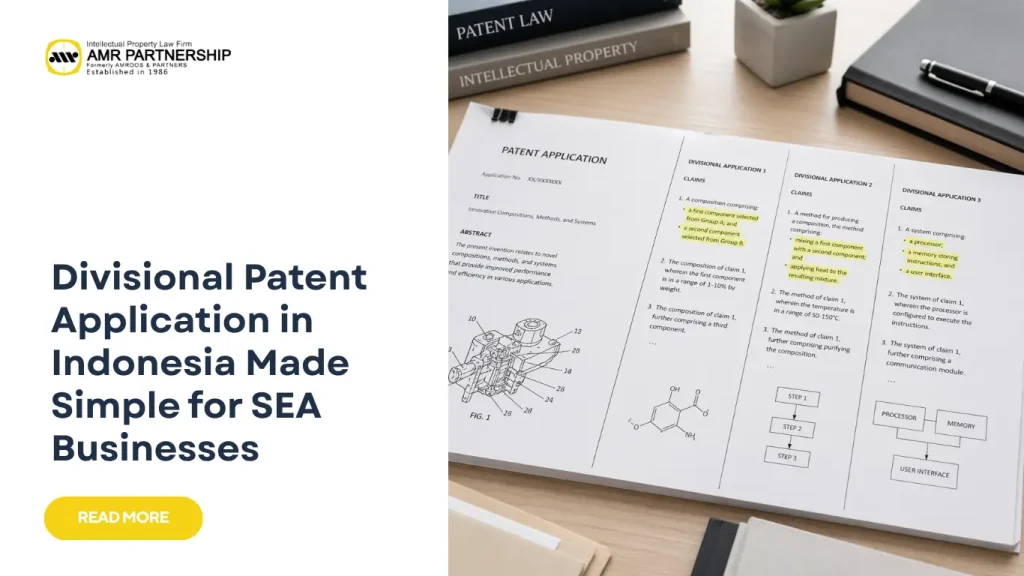
At its core, a divisional lets you split one patent application into multiple ones, each covering a different invention, while keeping the same priority date.
This right comes from the Paris Convention for the Protection of Industrial Property, which ensures your original filing date is preserved—even after division.
Simple in theory. Strategic in practice.
Why Indonesia requires a different mindset
Indonesia isn’t just another ASEAN filing destination. It operates under Indonesian Patent Law No. 13 of 2016, and while the law hasn’t drastically changed, how it’s applied today is more structured and less forgiving than many expect.
For regional companies, especially those used to more flexible systems, this is where issues start.
Timing is flexible—but don’t push it
On paper, Indonesia gives you room:
- You can file a divisional before the parent is granted, or
- Before it’s rejected
No tight 2–3 month window like in some jurisdictions.
But here’s the catch:
Waiting too long can trigger procedural friction—from examiner pushback to missed strategic opportunities.
👉 In real-world practice, earlier is safer.
The rule that changes everything: no claim broadening
This is where many Southeast Asian applicants slip.
In Indonesia:
- You cannot expand beyond the original disclosure
- You cannot reshape claims to go wider than the parent
So if your initial drafting isn’t solid, a divisional won’t fix it later.
Overlapping claims? Not here
Unlike more flexible systems, Indonesia expects:
- Clear separation between inventions
- Non-overlapping claim scope
That means you need to define your invention boundaries early—because you won’t get a second chance to adjust creatively later.
Can you still use divisionals strategically?
Yes—but with discipline.
Indonesia allows:
- Continued prosecution via divisionals
- Even divisional of divisional filings
But it’s not a workaround tool. It’s a structured extension, not a strategic reset.
Where SEA companies usually get it wrong
Across the region, we see the same patterns:
- Assuming ASEAN systems are aligned
- Reusing claim strategies from Singapore or Malaysia
- Filing divisionals too late in the process
- Treating divisionals as a fallback instead of planning tool
These mistakes don’t just slow things down—they can limit your protection entirely.
A smarter approach for Indonesia filings
If Indonesia is part of your regional expansion:
- Identify multiple inventions from the start
- Build fallback positions early—not during examination
- Align your Indonesia filing with your overall SEA strategy
- Treat divisionals as part of planning—not damage control
READ MORE : Patent Indonesia
Getting Your Strategy Right in Indonesia
A divisional patent application in Indonesia isn’t complicated—but it is specific.
And that specificity is where most international strategies break down.
For Southeast Asian businesses, success in Indonesia comes down to one thing:
adapting early, not reacting late.
If you get that right, divisionals become a powerful tool—not a missed opportunity.
For more information about AMR Partnership, feel free to contact us:
- Phone (Hunting): +62-21-29036668
- Fax: +62-21-29036672 to 75
- WhatsApp Customer Service: Click here to chat
- Instagram: @amrpartnership
- TikTok: @amr.partnership
- Facebook: Law Firm AMR Partnership
- Official Website: www.amr.co.id