Fresh from INTA 2026 in London, one message stood out: trademark protection is no longer a simple filing exercise. For global businesses entering Southeast Asia, fragmented regulations, AI-driven brand misuse, and cross-border enforcement challenges make strategic legal planning essential before launch.
At INTA 2026 in London, one theme consistently surfaced across conversations in the global Intellectual Property community: brand protection is becoming more complex, more commercial, and far less predictable.
For businesses eyeing Southeast Asia, that matters—especially for companies looking for an international trademark lawyer SEA strategy rather than simple trademark filing support.
The region remains one of the world’s most compelling growth markets. According to the Google-Temasek-Bain e-Conomy SEA Report, Southeast Asia’s digital economy is projected to reach US$1 trillion by 2030. At the same time, the World Intellectual Property Organization (WIPO) recorded 11.6 million trademark applications globally in 2024, highlighting just how competitive brand ownership has become.
In other words, expansion opportunity is growing—but so is trademark risk.
Why Trademark Risk in Southeast Asia Looks Different in 2026
Many international businesses still approach trademark protection with a simple assumption: file the trademark, secure approval, and move forward.
That approach no longer reflects reality.
Southeast Asia is not a single legal market. Each jurisdiction has its own filing procedures, enforcement standards, timelines, and practical challenges. A strategy that works in one country may be ineffective in another.
Digital commerce has only added more complexity. Cross-border e-commerce has accelerated counterfeit distribution, unauthorized seller activity, and brand impersonation. Artificial Intelligence introduces newer risks, from synthetic brand misuse to misleading digital representations that can damage brand trust before businesses even establish market presence.
This is why trademark registration alone is no longer enough.
Trademark Mistakes Are Business Problems, Not Just Legal Problems
For growth-focused companies, trademark strategy directly affects commercial outcomes.
A weak trademark approach can lead to:
- delayed market entry
- forced rebranding after launch
- wasted marketing spend
- investor due diligence concerns
- distributor negotiation complications
- expensive enforcement disputes
For international businesses moving quickly, these costs are not theoretical.
A product launch delayed by a trademark conflict can disrupt revenue forecasts. A rebrand after market entry can erase months of marketing investment. Unclear ownership can complicate partnerships, licensing, or franchise discussions.
That is why sophisticated businesses increasingly treat trademark planning as part of market-entry strategy—not administrative paperwork.
Filing a Trademark Is Not the Same as Protecting a Brand
One of the most common misconceptions is assuming broader filing always means stronger protection.
In reality, smart protection is strategic.
Before entering Southeast Asia, businesses need to assess whether their brand can legally operate in target markets without conflicting with existing rights. This often includes clearance reviews, risk assessments, enforcement planning, and jurisdiction prioritization.
For example, a company entering Singapore and Indonesia may need a very different trademark strategy compared to a business prioritizing Vietnam, Thailand, or broader regional licensing.
The right approach depends on factors such as:
- target customer markets
- supply chain exposure
- counterfeit vulnerability
- online marketplace risks
- distribution models
- enforcement practicality in each jurisdiction
This is where an experienced international trademark lawyer SEA becomes commercially valuable—not simply to file, but to help businesses make better expansion decisions.
Why Global Perspective Matters More Than Ever
Trademark law no longer operates in isolation.
Global trade shifts, digital marketplace enforcement, AI governance, and evolving Intellectual Property regulation are reshaping how brands protect commercial value.
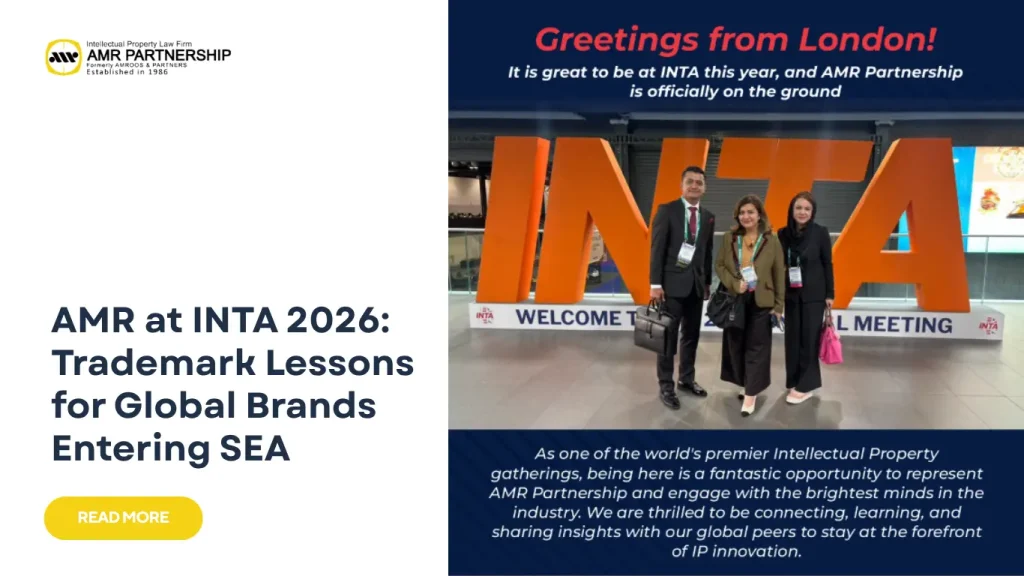
That was one of the clearest takeaways from INTA 2026, where AMR Partnership was on the ground engaging with the broader international IP community and staying close to developments shaping modern trademark strategy.
For businesses expanding into Southeast Asia, working with legal counsel that understands both regional realities and global trends offers a meaningful advantage.
Established in 1986, AMR Partnership has built its practice around Intellectual Property law, advising businesses on trademark prosecution, enforcement, portfolio strategy, and broader brand protection matters.
For international companies, this combination matters. Southeast Asia requires local understanding—but increasingly, it also demands international perspective.
Expanding Into Southeast Asia? Start With Strategy
Southeast Asia offers significant commercial opportunity. But in 2026, successful expansion depends on more than speed.
The better question is no longer:
“Have we filed our trademark?”
It is:
“Is our brand actually prepared to operate and scale across Southeast Asia?”
For global businesses, choosing the right international trademark lawyer SEA partner can significantly reduce expansion risk while strengthening long-term brand protection.
That distinction often determines whether expansion becomes a growth opportunity—or a costly correction.
Sources: World Intellectual Property Organization (WIPO), Google-Temasek-Bain e-Conomy SEA Report, international industry discussions at INTA 2026.
- Phone (Hunting): +62-21-29036668
- Fax: +62-21-29036672 to 75
- WhatsApp Customer Service: Click here to chat
- Instagram: @amrpartnership
- TikTok: @amr.partnership
- Facebook: Law Firm AMR Partnership
- Official Website: www.amr.co.id